
Covington Supervision Office Role
MDOC identifies the Covington Probation & Parole Office as a Community Corrections location. It serves the community side of state corrections for relevant cases. It does not book detainees, hold people awaiting court, calculate bond, or issue a county jail release record. A person who reports here may be on parole after prison, on Earned Release Supervision, or on probation imposed by a court.
The Mississippi State Parole Board decides whether to grant or revoke parole. MDOC calculates eligibility and supervises parolees. A court orders probation. This division matters because no one office record answers all release questions. Board action supports the parole decision, the MDOC public search can support current status, the field office routes supervision matters, and the original prison or jail record establishes the physical departure.
| Status | How it begins | What it proves |
|---|---|---|
| Parole | Parole Board grants conditional release | Release from prison confinement with supervision |
| Probation | Court orders a community sentence or suspended term | Community supervision, not always a prison release |
| Earned Release Supervision | Eligible prisoner leaves confinement under MDOC rules | Outside prison while retaining inmate status and MDOC jurisdiction |
| Discharge | Sentence and applicable supervision end | End of the stated corrections authority |
Verify Covington Parole Status
MDOC maintains separate Inmate Search and Parolees Search tools. The parole search accepts first name, last name, or MDOC ID and offers a county selector that includes Covington. Use the MDOC number when possible because names can collide. A positive match supports a post-prison supervision status, but it is not proof of final sentence discharge.
County filtering calls for care. A person convicted in Covington County may live under supervision elsewhere. Someone assigned to the Covington office may have been convicted in another county. Compare the name and MDOC ID, then use birth date or other displayed identifiers where available. Do not treat a county-filter result as proof of a past booking in Covington County Jail.
- Search the MDOC Parolees Search by MDOC ID or exact name.
- Use the Covington county filter as a narrowing aid, not a final identity test.
- Compare identifiers and record the exact status wording shown.
- Check the Inmate Search if continuing confinement or a return to custody is possible.
- Seek a Board action or MDOC status record when formal proof is needed.
Note: Absence from the parolee search does not prove discharge, and an office assignment does not establish final sentence completion.
Covington Office Contact Record
The field office is the local point for general routing tied to MDOC community supervision. Its official profile names the Community Corrections Director and lists a street address, mailing address, phone, and fax. The page does not publish hours, public walk-in rules, reporting days, or a verification promise. Call before visiting. People under supervision must follow their own officer's directions rather than general web instructions.
Covington Probation & Parole Office
Jason Carney, Community Corrections Director
101 South Dogwood Avenue
Collins, MS 39428
Mail: PO Box 667, Collins, MS 39428
Phone: 601-782-9512
Fax: 601-782-4471
Public hours: not listed
The official MDOC office profile confirms this local post-release contact. The captured profile helps distinguish the Collins, Mississippi office from unrelated agencies and same-name counties.
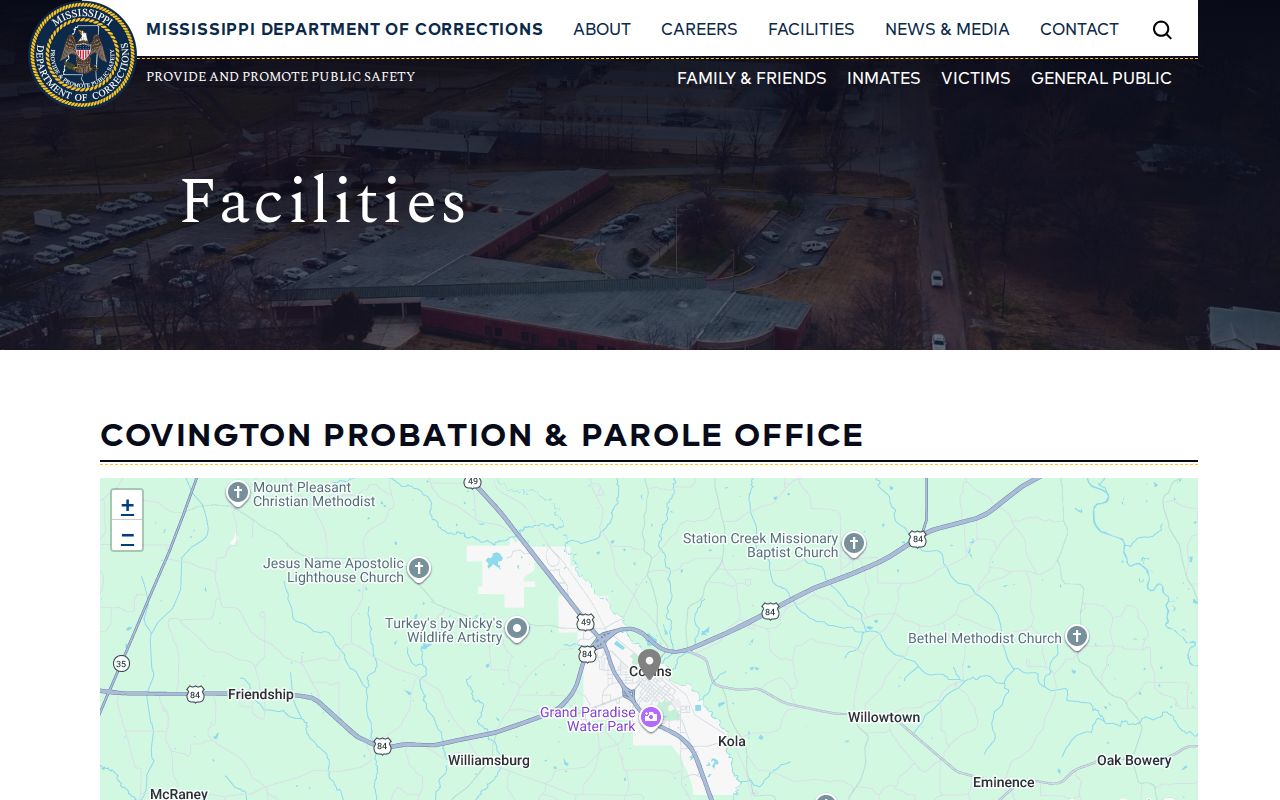
The image supports office identity and routing, but it contains no open case roster and should not be treated as proof of anyone's supervision status.
Covington Parole Reporting Rule
Mississippi Parole Board rules require a parolee to report to the field officer within 24 hours of actual release unless directed otherwise. This gives the Covington office a meaningful place in the local release chain. It does not create a public walk-in service for people trying to inspect someone else's file. The rule governs the parolee's conduct after release.
The office page does not state check-in methods or days. Only the person's release paperwork and officer instructions should guide reporting. A family member trying to confirm a release may use the parole search and then call for general public routing. Sensitive facts or field notes may not be disclosed. If an urgent safety or custody issue exists, use the agency channel responsible for that issue rather than assuming the field office can release case details.
Supervision is not discharge. A person may live in the community while still subject to MDOC jurisdiction, conditions, reporting, and possible revocation.
Covington Field Record Limits
MDOC's public-records policy exempts any and all records of a parole or probation field officer. A broad demand for supervision notes is therefore poorly aimed. A focused request can instead ask MDOC for the public status or dates, a release or discharge record, a final Board action sheet if maintained, or another specifically identified nonexempt record.
No current Covington County absconder or warrant list was verified. A 2020 report said the former sheriff site had a Most Wanted feature, but that site is no longer available. An old wanted notice cannot prove present custody or an active supervision violation. A warrant may also coexist with a valid earlier release, so it does not erase that earlier custody event.
For a possible violation, check MDOC's current public tools, call the Covington office for appropriate routing, and use a filed court or Board record where it applies. The Thirteenth Circuit MEC flag dictionary includes Probation Violation Pending, PRS Violation Pending, MDOC Warrant Issued, and Bench Warrant Issued. These administrative flags are leads, not automatic proof that a person has been arrested or returned to prison.
Covington Board Action Records
Parole hearings and supervision are related but separate. The Board has exclusive authority to grant or revoke parole. MDOC supervises after release. No official public calendar listing individual hearings was found, and no public decisions database was verified. Official rules say hearings are closed and may occur by file review, in person, telephone, or teleconference.
The Board gives the inmate written notice after deliberation. A denial action sheet states reasons and a future set-off period. The Board preserves official actions and reasons in a minute book. People seeking public, releasable proof should ask whether a named person's Board action, public parole date, or decision record can be provided. Date-calculation questions belong to MDOC, while Board decision questions belong to the Board.
Mississippi State Parole Board
239 North Lamar Street, Suite 501
Jackson, MS 39201
Phone: 601-576-3520
Email: MSStateParoleBoard@mdoc.state.ms.us
Eligibility is not a release date. Offense class, exclusions, sentence law, and the Board's discretionary decision affect the result. A predicted hearing month should never be converted into a claim that someone left confinement.
Covington Supervision Evidence Chain
The most reliable proof uses sources that answer distinct questions. A prison release record establishes departure from confinement. A Board action explains a parole grant. The Parolees Search supports current public supervision status. The Covington office is the local routing point. A discharge record answers whether the authority later ended. When these sources conflict, preserve the exact wording and ask the record-owning agency to explain or correct it.
- Absconder
- A person alleged to have stopped complying with required supervision contact; the term does not by itself prove present custody.
- Revocation
- An official action ending community release and potentially returning a person to confinement.
- Board action
- The Parole Board's formal grant, denial, or revocation decision.
- Field record
- An officer's supervision file, which MDOC policy treats as exempt.
Someone whose status began at the county jail needs a separate Covington jail-docket check. The Covington County release-record search path explains how to pair local custody evidence with state supervision and court records.
Official Covington Supervision Sources
The MDOC home page separates inmate and parole searches. The Mississippi State Parole Board directory supplies the decision-agency route, and MDOC GovQA accepts focused records requests when public search results do not establish release or discharge.
Keep a dated copy of the exact public result and note whether it came from the inmate or parole search. If the status is disputed, ask for the narrow record that resolves the point instead of requesting an officer's full file. A release record, Board action, public status date, or discharge record has a defined purpose. The Covington office can route a general question, but its staff should not be expected to disclose confidential reporting details, conditions, contacts, or case notes. Court records remain the right source for probation imposed by a judge. This division protects accuracy and keeps a community supervision check tied to the agency that created each fact.
Covington Status Verification Notes
A court probation flag, parolee-search match, office assignment, and final discharge record are distinct evidence. Cite the exact source and date for each status. If only one source is available, keep the conclusion limited to the fact that source actually reports.
Public Record Search
Sponsored Results