
Covington Parole and Probation Differences
Parole, probation, and earned release supervision describe different legal positions. The Mississippi State Parole Board has the power to grant or revoke parole. The Mississippi Department of Corrections, or MDOC, calculates eligibility and supervises parolees after they leave confinement. Probation comes from a court judgment. It may follow jail or prison, but it can also be imposed as a community sentence or with a suspended term. A person on probation should not be described as a released state prisoner unless the custody record supports that history.
Earned Release Supervision, often called ERS, is another distinct path. An eligible person lives outside prison while retaining inmate status and remaining under MDOC jurisdiction until the sentence expires. Final discharge is different from all three statuses because discharge means the relevant sentence and supervision have ended. The comparison below helps identify which Covington County record should answer the question.
| Status | Who creates or decides it | Best public evidence |
|---|---|---|
| Parole | Mississippi State Parole Board grants or revokes it; MDOC supervises it | MDOC Parolees Search plus the Board action or public parole record |
| Probation | Justice or Circuit Court enters it in a judgment | Filed judgment, docket entries, and public MDOC status where available |
| Earned Release Supervision | MDOC applies the statutory sentence framework | MDOC status and a release, time-sheet, or computation record |
| Final discharge | The responsible court or corrections authority records completion | Discharge record or filed court order, not mere search absence |
Key terms matter when records are compared. An absconder is a supervised person reported as no longer complying with required contact or location rules. A revocation is an official action that ends parole or probation and may return the person to custody. A detainer is a request by another authority to hold or take custody. None of those terms should be inferred from a missing search result.
Verify Covington Post-Release Supervision
The most reliable check uses a status source and a legal source. Start with a stable identifier. MDOC ID is best for a state corrections record because names can collide, change, or appear in different forms. The public parole tool also permits a Covington county filter, but that filter requires care. A person convicted in Covington County may be supervised elsewhere, while a person assigned to the Collins office may have been convicted in a different county.
- Open the official MDOC Parolees Search. Search by MDOC ID when known, or use first and last name.
- Try the Covington county filter, then repeat without it if the expected record does not appear. Compare all available identifiers before accepting a match.
- For a possible state-prison status, also check the MDOC Inmate Search. A current institution or unit indicates continuing state custody, not parole.
- Review the applicable Covington court record for a probation judgment, revocation filing, warrant flag, or discharge order. A docket flag is a lead; the filed order is stronger.
- Call the local MDOC office for general routing and the portion of status that staff may lawfully confirm. Seek a Board action or discharge record when the public tools are incomplete.
For a county-jail departure, first confirm the terminal event through the sheriff-held jail docket. The official county page for Sheriff Darrell M. Perkins identifies the sheriff as jailor and keeper of that docket. A transfer from Covington County Jail to MDOC is not a community release. The broader Covington County released inmate search and records path explains how to separate jail release, transfer, and continuing state custody.
Note: Record the search date because state status, court entries, and warrant information can change after a release event.
Covington Parolees Search Evidence
MDOC runs separate public tools for inmates and parolees. That design is important. The inmate tool covers people within state corrections custody and displays sentence and location data. The parolee tool addresses a form of post-prison community supervision. Neither one is a complete archive of every person booked at Covington County Jail, and absence from both does not prove that a sentence never existed or that supervision has ended.
The official MDOC parole search is shown below with its distinct name, ID, and county search options.
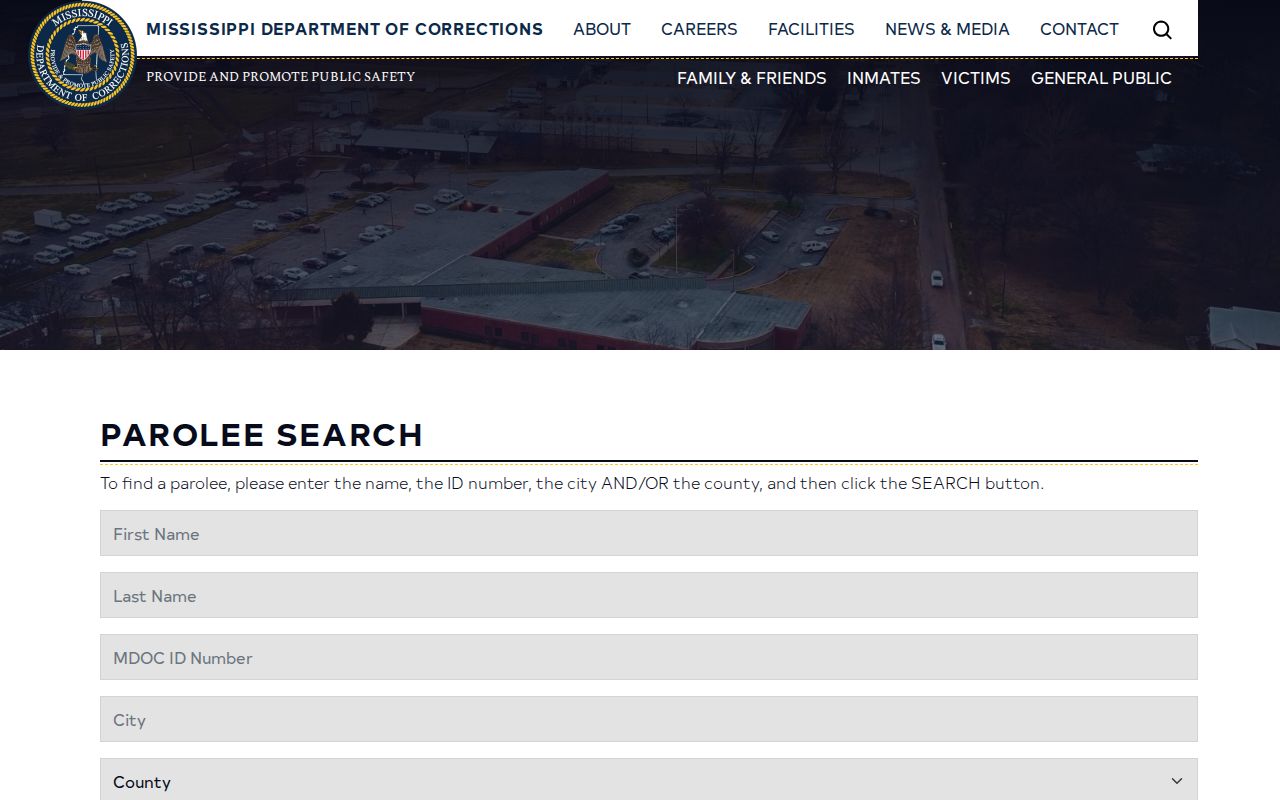
The separate form is why a state inmate lookup alone is not enough when parole is plausible. Compare any result with a Board record or court filing before treating a public status as the full legal history.
When no public result resolves the question, a narrow records request is better than guesswork. Ask for a public parole or ERS status, release date, discharge date, or final Board action. MDOC policy exempts all parole and probation field-officer records, so do not request supervision notes as though they were public. Target the status and formal action that can be segregated from protected case material.
Covington Supervision Office After Release
MDOC maintains a named local field office in Collins. It is a community corrections office, not a jail and not the Parole Board. Its role begins on the community side of relevant MDOC cases. Official Board rules require a parolee to report to the field officer within 24 hours after actual release unless other directions were given. That rule explains the office's local importance, but it is a duty placed on the parolee, not a promise that public visitors may arrive without an appointment.
Covington Probation & Parole Office
Jason Carney, Community Corrections Director
101 South Dogwood Avenue
Collins, MS 39428
PO Box 667
Collins, MS 39428
Phone: 601-782-9512
Fax: 601-782-4471
The office page does not publish walk-in hours, reporting days, an appointment system, or public check-in directions. A person under supervision must follow instructions from MDOC. Someone seeking general confirmation should call first and recognize that staff may limit what they disclose. For formal proof, use the public search, a Board action, or a nonexempt status record.
The official Covington office listing provides the local details pictured below.
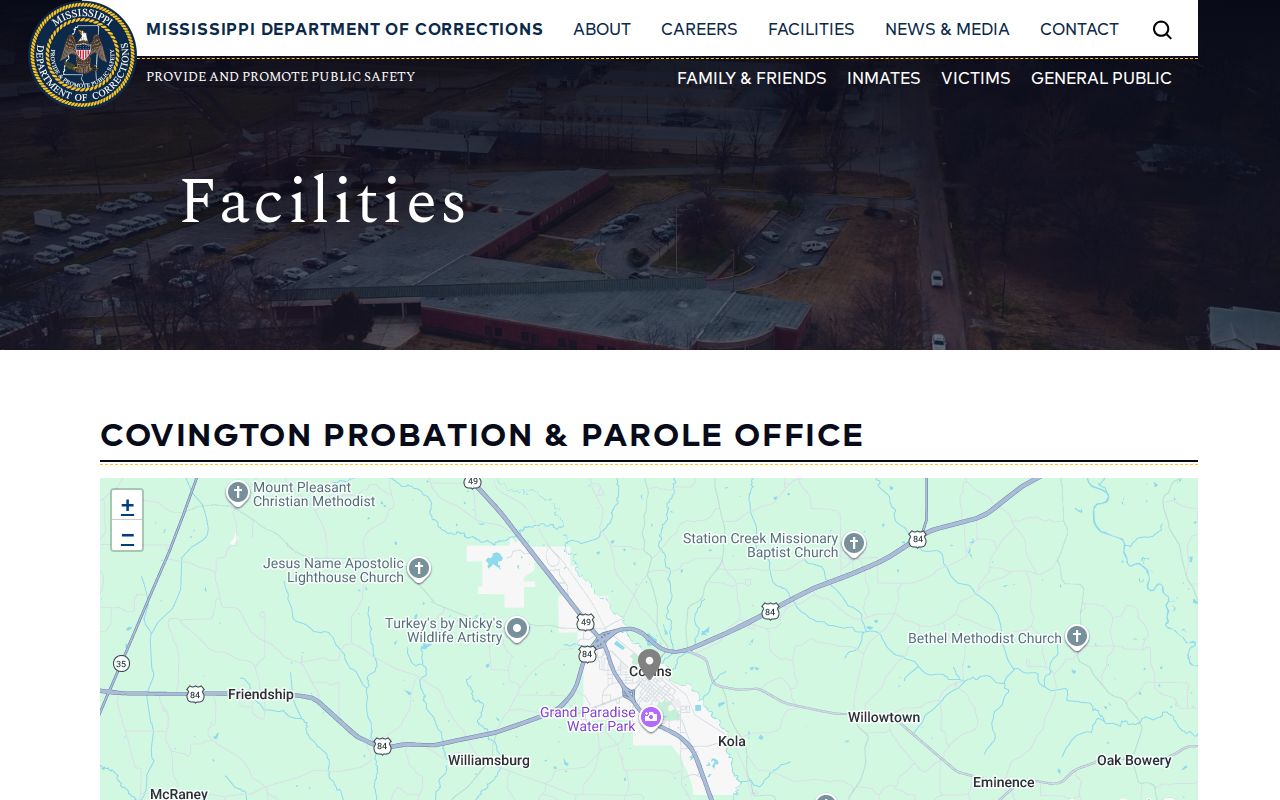
This listing supports the Collins contact route while also showing why readers should not invent office hours or a public reporting procedure.
Note: The Parole Board makes parole decisions; the Collins MDOC office handles community supervision and cannot be treated as the Board.
Covington Absconder and Warrant Checks
No current Covington County absconder or supervision-warrant list was verified. A 2020 news report said the sheriff's former website included a Most Wanted feature, but that website is now unavailable. An old wanted notice cannot establish a person's current supervision or custody status. It may reflect a past allegation, a resolved warrant, or information that was accurate only when posted.
Possible violations should be checked through current MDOC tools, the Covington field office, and the court record. The Thirteenth Circuit MEC flag dictionary includes Probation Violation Pending, PRS Violation Pending, MDOC Warrant Issued, and Bench Warrant Issued. Those administrative flags can point to a filing. They do not prove the person has been arrested, returned to the county jail, or had supervision revoked. Read the docket entry or filed order and confirm physical custody with the agency that would hold the person.
Conditions and violations vary by judgment, Board action, and MDOC instructions. High-level conditions may involve reporting, travel limits, lawful conduct, and compliance with case-specific directions. A violation allegation is not the same as a final revocation. Revocation requires official action, and the resulting record should state whether the person remains in the community, has been detained, or returned to confinement.
Covington Parole Hearings and Decisions
The Mississippi State Parole Board has exclusive power to grant or revoke parole. MDOC calculates eligibility, but an eligibility date is only the point at which consideration may occur. It is not a promised release date. Offense, sentence date, exclusions, case facts, and the Board's discretion can all affect the result.
No official public calendar of individual parole hearings and no public decisions database were verified. The Parole Board administrative rules state that hearings are closed. Staff set the appointment and notify authorized legal counsel, and a matter may proceed through file review, an in-person process, telephone, or teleconference. The rules require a hearing no later than 30 days before the eligibility month, allowing consideration in that month or either of the prior two months. That timing framework is not a public monthly schedule.
After deliberation, the Board advises the inmate in writing within 10 days. A denial action sheet gives reasons and a future set-off period. Official materials support grant, denial, later consideration, and revocation. For a named person, seek the releasable Board action sheet, decision, public parole date, or minute-book action. A parolee-search match paired with the Board's action is stronger evidence than an expected hearing date.
Note: Questions about date calculation belong to MDOC, while questions about a grant or denial belong to the Parole Board.
When Covington Supervision Ends
Leaving prison and ending legal supervision are separate events. A parolee has left confinement under conditions but remains subject to the sentence and Board authority. A person on ERS remains an inmate under MDOC jurisdiction until sentence expiration. Probation continues according to the court judgment until the court or responsible agency records completion, discharge, revocation, or another lawful change.
Do not treat disappearance from the Parolees Search as proof of discharge. Public search retention is not established as a complete historic record. Seek a discharge record, final Board action, MDOC release record, or court order that answers the actual question. If the source reports parole, probation, ERS, revocation, or discharge, preserve that exact term. Flattening each event into “released” hides whether supervision and legal duties remain.
A useful evidence chain pairs the custody event with the terminal supervision record: the jail or MDOC release entry shows departure from confinement, and the Board, MDOC, or court document shows the status that followed. That distinction protects against claiming full freedom when the record supports only release from one custodian.