
Covington Prison Locations Outside County
No MDOC prison was identified inside Covington County in the official facilities directory. That does not mean a person convicted there never entered state custody. After a sentenced person leaves Covington County Jail for MDOC, the department can receive and house that person elsewhere in Mississippi. The MDOC detail's current location and location-change date are better evidence than a geographical assumption.
The sending jail record and receiving state record serve different roles. The county docket may show “transferred to MDOC” and a terminal county timestamp. MDOC's record then shows state entry, placement, sentence, conviction county, and other corrections data. Calling that county event a release to the community would be wrong. It ended one custodian's control while another took over.
| Event | Custody result | Confirm through |
|---|---|---|
| County transfer to MDOC | State confinement continues | Jail docket plus MDOC detail |
| Move between MDOC facilities | State confinement continues | MDOC location and change date |
| Parole | Community placement under supervision | Parolees Search and Board action |
| Earned Release Supervision | Outside prison, still an inmate under MDOC jurisdiction | MDOC status and release record |
| Final discharge | Specified sentence authority ends | MDOC discharge record |
Search Covington MDOC Prison Records
The MDOC Inmate Search accepts first name, last name, or MDOC ID. Use the ID whenever it is available. After opening a likely match, compare birth date, county of conviction, sentence date, entry date, offenses, sentence length, current location, unit, and location-change date. Covington as the conviction county can support identity, but it does not prove that the person was held in Covington County Jail for that sentence.
Search the same person in the separate Parolees Search when parole is plausible. A parolee result supports release from confinement into community supervision. It does not establish final discharge. No captured official page proved that all fully discharged people remain searchable with one standard Released or Discharged label. Absence from both public searches must remain inconclusive.
- Obtain the MDOC ID or preserve all known name variants and birth information.
- Run the Inmate Search and open the record that best matches the full identity.
- Read current location and sentence data before focusing on a date.
- Run the Parolees Search and use county filtering only as a narrowing tool.
- Request the release or discharge record when the public pages do not prove the historical event.
Note: A current MDOC location means state custody continues, even if the person has left Covington County Jail.
MDOC Tentative Release Record
Mississippi's public detail uses the exact label “Tentative Release Date.” The field predicts a calculated event and does not confirm that release happened. The MDOC handbook treats parole, Earned Release Supervision, tentative release or discharge, and maximum release as distinct dates. Sentence structure, credit, earned time, forfeiture, exclusions, detainers, and later decisions may change the calculation.
An official example displays the field with a date, while another life-term example leaves it blank. Never fill a blank with homemade arithmetic. A tentative date is not a parole hearing date, an ERS date, a mandatory discharge date, or an actual release date unless another official record connects those concepts. For historical proof, ask MDOC for the actual release mechanism and date, release or discharge record, and time or computation sheet.
Scheduled is not completed. Use the Tentative Release Date for planning a verification check, then confirm the actual event with MDOC.
The official MDOC detail example shows the identification, sentence, location, photograph, and tentative-date fields available in a state record.
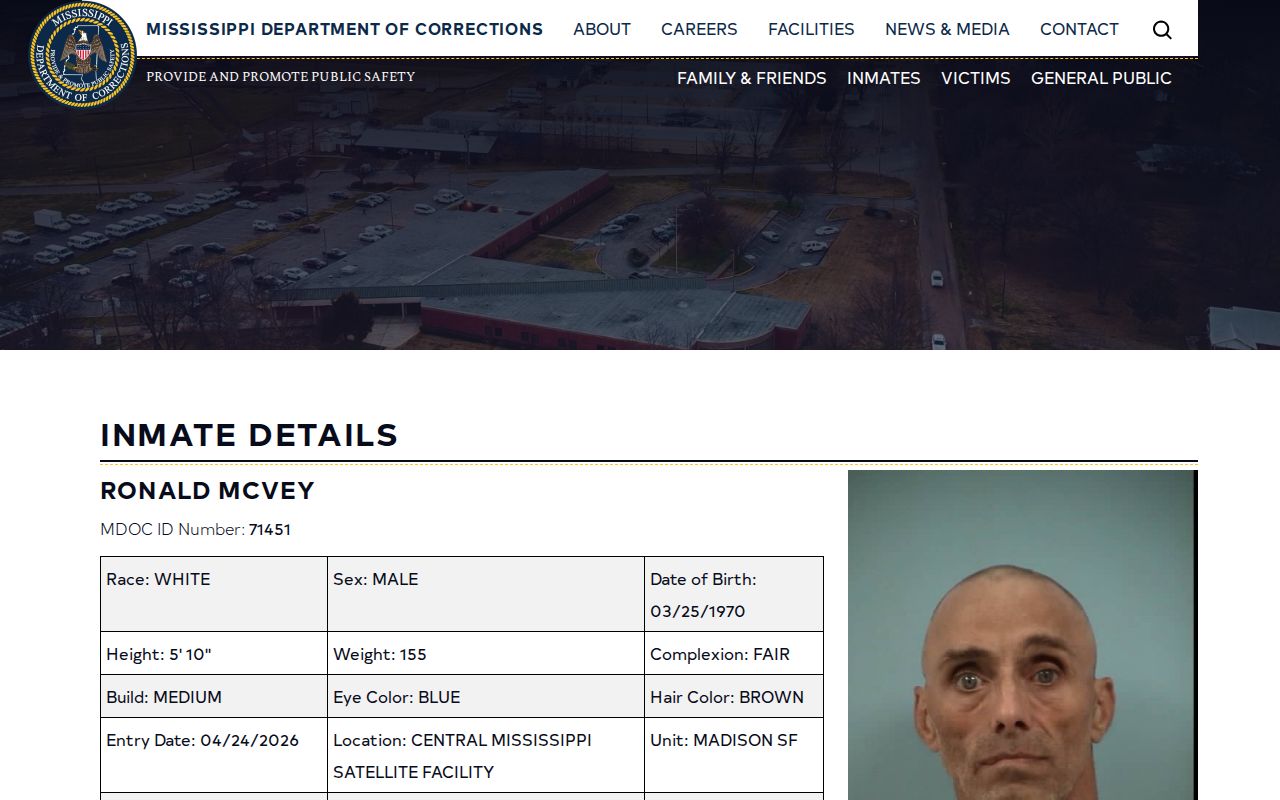
The captured result demonstrates the field set, but its sample person's facts should not be generalized to a Covington County case.
Covington MDOC Discharge Requests
When public searches cannot establish actual departure or final discharge, use the MDOC GovQA records route. Describe existing records with enough detail to identify the person and event. Useful targets include the release or discharge record, time sheet or computation sheet, actual release date and mechanism, maximum discharge date, public parole or ERS status, latest releasable MDOC identification photograph, and final Board action sheet if maintained.
MDOC Public Records Officer
301 North Lamar Street
Jackson, MS 39201
Phone: 601-359-5600
Scheduled inspection: working days, 8:00 a.m. to 5:00 p.m.
Online requests: MDOC GovQA
MDOC says a written request must identify existing records and provide contact details. Its policy describes a written response within seven working days and production no later than fourteen working days after the request and payment, unless more time is needed. Copies cost $0.15 per page. Work beyond one hour may be charged at the lowest qualified employee's rate, with vendor, technology, or mailing costs where applicable.
The MDOC GovQA portal is the documented submission channel. Request a cost estimate when the scope may require more than a short retrieval.
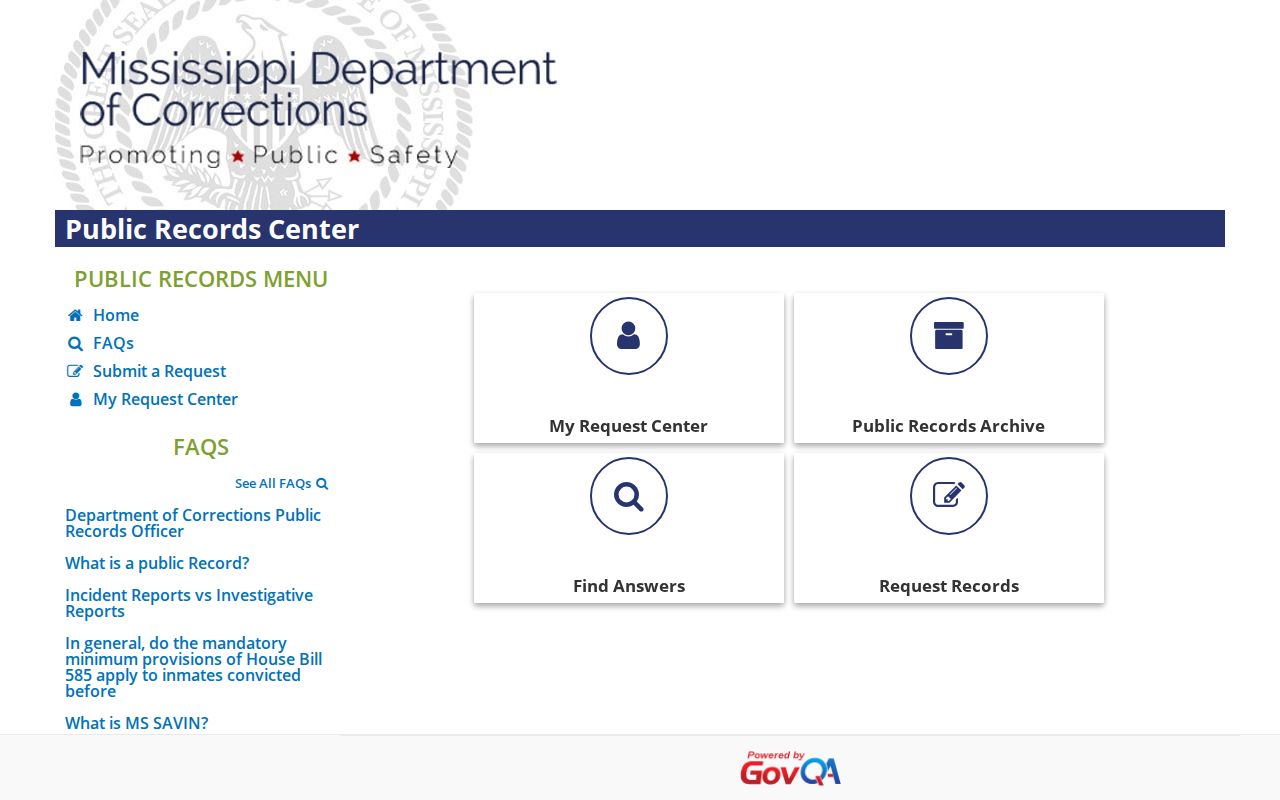
The portal image shows where a focused state request begins after the public locator cannot prove release or discharge.
Covington Parole After Prison
The Mississippi State Parole Board decides whether to grant or revoke parole. MDOC calculates parole eligibility and supervises people after release. These functions should not be merged. An eligibility date is not a grant. A Board grant is not final discharge. A parolee-search match supports a community supervision status but says that state authority continues.
For local routing, MDOC maintains the Covington Probation & Parole Office in Collins. Its official page lists no public hours or walk-in verification process. Call for general routing. Board rules require a parolee to report to the field officer within 24 hours of actual release unless directed otherwise, but that duty is for the supervised person. Field-officer records are exempt under MDOC policy, so a public request should target status, dates, Board action, or discharge rather than officer notes.
- Parole
- Conditional release from prison after Board action.
- Earned Release Supervision
- Release from confinement with inmate status and MDOC jurisdiction continuing.
- Tentative Release Date
- A projected MDOC field that can change and may be blank.
- Maximum release
- A distinct sentence-computation date, not a synonym for parole.
- Discharge
- The recorded end of the sentence or supervision authority at issue.
Covington MDOC Identity Checks
Names alone are weak identifiers. Compare MDOC ID, birth date, conviction county, sentence, entry date, and current location. A photograph can help orient the search but should not be the sole match. State corrections photographs are not necessarily the same images taken during a Covington County booking.
VINE can add an agency-fed custody event or notification where the relevant MDOC record participates. Its result may show a custody change, yet it is not a certified release reason. VINE cannot alter facility-supplied data. Corrections should go to the agency that feeds the record. For a court explanation, review the Covington felony docket or filed order; for the physical state event, seek MDOC confirmation.
Records before and after confinement can overlap. A person may be listed in a state search, a court docket, a parole search, and an offense-limited registry for different reasons. Each system has its own scope. The most sound result names what each source proves and does not transform “not found” into a claim of freedom or discharge.
Covington State Release Evidence
A complete evidence chain starts with custody. Match a county transfer entry to MDOC intake when the path began at Covington County Jail. Use the current state location for ongoing confinement. Pair parole status with a Board action when available. For actual release or final discharge, request the state record that names the event and date. This approach preserves the difference between leaving a building and leaving corrections authority.
No facility-specific release gate, transportation practice, property process, or visitor rule can be stated for a generic statewide MDOC page. The listed page represents many prisons, regional or county placements holding state prisoners, and other department locations outside Covington County. Contact the current facility shown in the record for current operational questions.
The Covington County released-inmate search connects this state route with the county jail docket, court records, and federal distinctions.
Official Covington MDOC Sources
The MDOC facilities directory confirms that no state prison was identified inside Covington County. The separate Parolees Search tests parole status after confinement, while the inmate search and GovQA route address custody details and formal release or discharge records.
Record each check date and preserve the exact location, status, and tentative-date wording. A later change does not make the earlier capture false; it may reflect a transfer, recalculation, parole action, or updated agency feed. When a Covington conviction has more than one sentence or hold, ask MDOC for the existing computation record instead of combining public fields into a new date. The department's record is the proper source for state calculations. The Covington court record remains useful for the judgment and sentence imposed, while MDOC documents how state custody administered that sentence.
Public Record Search
Sponsored Results